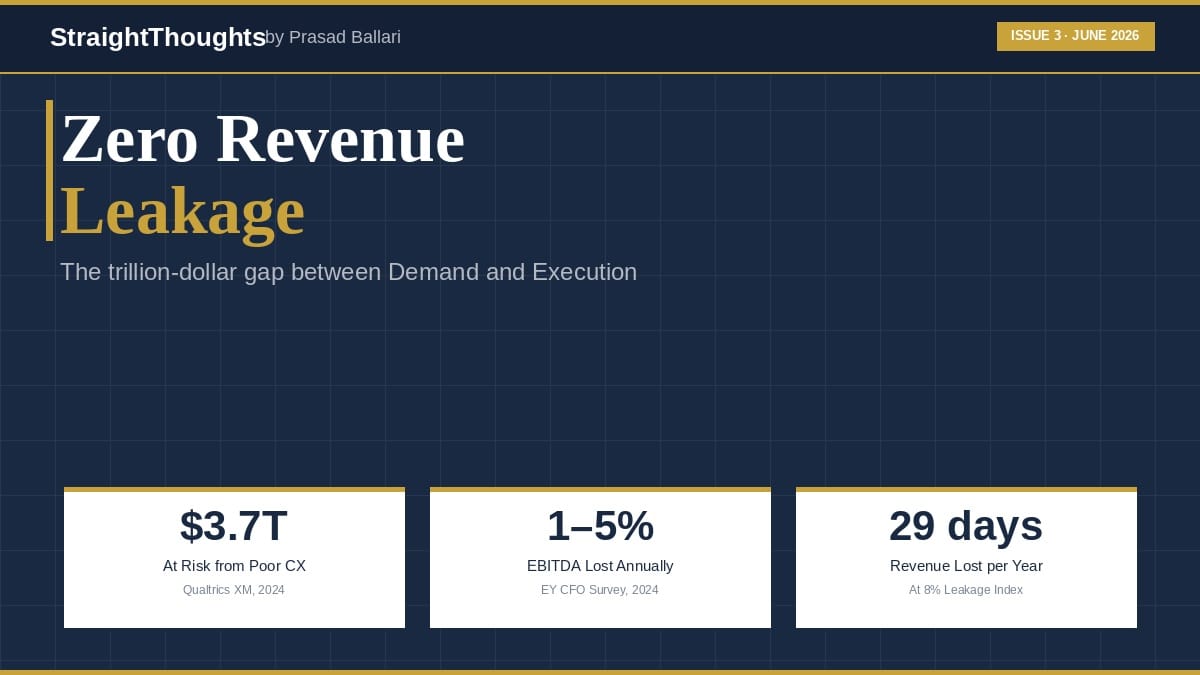
Zero Revenue Leakage
Most CEOs chase new revenue while 5–10% of existing revenue quietly walks away. Recover it and your growth target costs half as much to hit, flows at full margin, and starts this quarter — not next year.

The Straight Take
"We are spending more on marketing than ever. We are hiring better people. The product is the best it has been.
So why does the quarter feel harder than it should?
Why does the pipeline look full and the forecast keep slipping?
Why am I working twice as hard to grow at half the rate?"
The answer is not in the pipeline. It is in the gap.
Every business is built on two layers. Demand generates revenue — marketing, sales, brand. Execution delivers against it — operations, fulfilment, service. Between them sits a third layer. Your org chart is not built around it. I have been calling it Zero Leakage. The first place to apply it is revenue.
In the gap between Demand and Execution, revenue quietly disappears. A lead arrives — no one calls fast enough. A quote goes out — no one follows up. A customer drifts mid-journey and churns without a word. A delivery falls short, and the customer never tells you. They simply leave.
It does not show up in a churn report. It does not trigger a P&L alert. It compounds quietly, quarter after quarter — and it is hiding inside every business in the world right now.
You Have Already Felt This. You Just Have Not Named It.
Every CEO has explained away soft revenue this year using one of three sentences.
"The sales cycle is lengthening."
"Customers are more careful."
"We are being selective on which deals we chase."
Each is sometimes true. None is the whole truth.
The whole truth is harder. Some of that revenue was already yours — the lead earned, the product priced, the promise made, the deal booked. Somewhere between earning it and recognising it, you let it walk. Not in one visible loss. In a thousand quiet ones.
That is leakage. And leakage is structural, not cyclical. It does not fix itself when the market improves. It compounds until someone builds a layer to stop it.
The Three Causes
Trust is the scoreboard, not a cause. Every Experience failure, every Execution miss, every Attention lapse accrues to one place — your customer's willingness to keep doing business with you. Fix the three causes. Trust compounds upward.
The Revenue Moat Layer — Your Third Layer and Your Strongest Competitive Advantage
Most businesses have two layers. A few have three. The ones with three are beginning to pull away — and the gap is about to become very difficult to close.
Sales
Brand
Pipeline
Human Oversight
Watches Everything
Recovers What Leaks
Never Drops the Thread
Delivery
Fulfilment
Service
The Revenue Moat Layer is not a new team. It is not a new department. It is an agentic infrastructure — AI agents with human oversight — that sits permanently between your Demand and Execution layers, watching for every moment a customer, lead, or opportunity is about to walk away, and acting before they do.
It is not replacing your sales team, your account managers, or your support team. It is giving them an unfair advantage. The agent catches the lead at 2am. The agent surfaces the renewal 30 days early. The agent flags the delivery risk before the customer notices. The human makes the decision and closes it.
Here is the financial case, plainly. On a $50M business leaking 8% of revenue — that is $4M a year. Recovery of half that is $2M flowing straight to EBITDA at near-100% margin. No additional sales cost. No marketing spend. No new headcount. The Revenue Moat Layer self-funds from the revenue it recovers. In most businesses, it pays for itself inside one quarter.
Walk into your office on Monday. Ask three questions.
Of the leads that came in last week — how fast did we respond?
Of the renewals due this quarter — did we surface them, or did they surface themselves?
Of the complaints from last month — did the customer leave more loyal, or quietly less?
Every function owns its work. The question is the momentum. Most companies own slowly. The Revenue Moat Layer is the infrastructure that makes your team own fast — without burning them out.
This is why the AI moment matters here. The capability built for Zero Human Operations — agents that watch, follow up, and act without dropping the thread — is exactly what the Revenue Moat Layer runs on. Zero Revenue Leakage is the first business outcome that Zero Human Operations directly produces. The companies building their agentic infrastructure now are not just cutting operational cost. They are building the moat. The window to go first is open. It will not stay open.
The Metric — Leakage Index (LI)
Leakage Index (LI) is the percentage of revenue your business should have earned but didn't — across all three causes combined.
Best in class: <2% · Industry average: 5–10% · Underperforming: >15%
At 8% LI, your business works 29 days a year for free. That is the month of January — revenue earned, delivered, and lost before it reaches your P&L. Most CFOs have never calculated it. The ones who do change their priorities the same quarter.
As you build The Revenue Moat Layer, LI becomes the measure of how strong the moat is. A best-in-class LI below 2% means your competitors — still running at 8% — are losing a month of revenue every year that you are not.
What to Do This Quarter
- Calculate your Leakage Index this month. Take last quarter's pipeline. Compare what your team expected to close against what was actually recognised. In most businesses, the first number exceeds the current growth target on the board agenda. That is the moment priorities change.
- Decompose the leak across three causes. How much is Experience? How much is Execution? How much is Attention? Attention is almost always the largest — and the cheapest to close first.
- Put one name on the line. Revenue leakage has no single owner in most org charts. Every function owns an activity. Nobody owns the leakage itself. The moment that name exists, the problem becomes solvable.
- Begin building the Revenue Moat Layer with Attention first. Lead-response time. Follow-up cadence. Renewal alerts. Complaint escalation. These close in weeks, not quarters. AI agents are the infrastructure. Human oversight is the judgement. The combination is the moat.
- Track Trust as the scoreboard. Repeat rate. Referral rate. Review velocity. Trust lags the three causes by one to two quarters. If LI falls but trust does not rise within six months, you fixed the symptom, not the cause.
The Watch List
Five signals that will tell us whether the Revenue Moat Layer becomes a standard business architecture. Check these before Issue 4.
That's the straight thought.
Prasad Ballari · June 2026
Sources: Qualtrics XM Institute, $3.7 Trillion of 2024 Global Sales at Risk from Bad Customer Experiences, Feb 2024 · EY, How to Stop Revenue Leakage: Global CFO Survey, 2024 · MGI Research, Revenue Leakage Series, 2024 · Oldroyd, McElheran & Elkington, The Short Life of Online Sales Leads, Harvard Business Review, 2011 · Salesforce / Lead Response Management Study (cited by HBR & MIT Sloan) · PwC, Future of Customer Experience Survey, 2024.
Read every issue at www.straightthoughts.com
For direct conversation: [email protected]
If this issue made you rethink one number in your business, forward it to someone who needs to see it.