The Zero Human Operations Movement


The most consequential restructuring of the enterprise is happening silently. Here is what it means for the UK and the US.
FOR BUSINESS OWNERS · CEOS · CXOS · INVESTORS
The Straight Take
The operational layer of the enterprise is being rebuilt. Quietly. Deliberately. Faster than most boards are modelling. I have been calling it Zero-Human-Operations — ZHO. It is the structural shift that will define competitive positioning for the next decade.
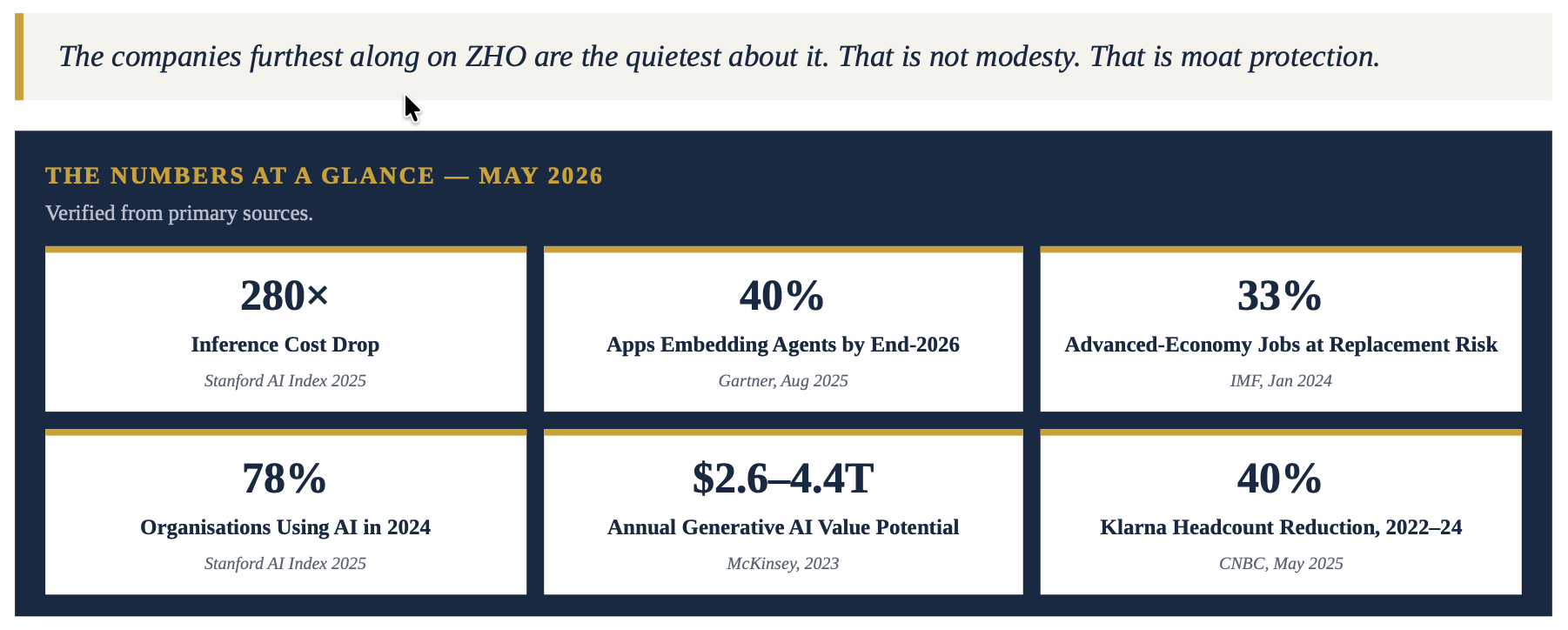
This is not augmentation. Not copilots. Not a productivity story. It is the deliberate redesign of business processes so that the default executor is an AI agent and the human is the exception. Gartner forecasts 40% of enterprise applications will embed task-specific AI agents by end-2026, up from less than 5% in 2025. The cost of running a model at GPT-3.5 capability fell more than 280-fold between November 2022 and October 2024 (Stanford AI Index 2025). When a capability gets 280 times cheaper in eighteen months, the conversation stops being about whether to use it.
Here is my take, plainly: the cost structure of an agent-forward company twelve months from now will be unrecognisable to a competitor who waited. The companies treating this as a vendor evaluation cycle are losing ground every quarter to the ones treating it as a structural redesign.
What Most People Are Missing
Yes, agents are improving. Yes, vendors are everywhere. You have read that. Here is what the commentary has glossed over.
This is not a productivity story. It is a unit-economics story. Productivity gains move a number on a slide. Unit-economics changes move the floor of what a competitor can charge and still make money. The 2023 wave — copilots, chatbots, summarisers — was a productivity skin on the same org chart. ZHO changes the org chart, the cost-to-serve, and the pricing power downstream of both.
Three forces converged in eighteen months. Reliability moved from demo-grade to ops-grade — Stanford reports AI performance jumping up to 67 percentage points on new benchmarks within a single year. Inference cost collapsed 280-fold.
Composability matured — open-weight models closed the performance gap with closed-weight models from 8% to 1.7% in twelve months. When all three arrive together, you do not get gradual adoption. You get replacement. The other thing missing from most analysis is the timing. Operational restructuring shows up two quarters after the decision is made — when headcount that did not get rehired stops being a line item and starts being a margin. The hiring freezes across knowledge-work sectors right now are partly a ZHO indicator misread as a recession indicator.
Contrarian Corner
One thing the market is getting wrong.
The consensus view is that AI augments knowledge workers, productivity rises ten to fifteen per cent, and the labour market absorbs the change. Equity markets are pricing roughly that. I think it is wrong.
The IMF's January 2024 finding: 33% of advanced-economy employment sits in high-exposure, low-complementarity occupations — meaning AI executes key tasks rather than enhancing them. That is not augmentation. That is replacement risk on a third of the labour pool. Klarna's headcount fell from 5,527 to 3,422 between end-2022 and end-2024 — a 40% reduction driven by AI plus a hiring freeze (CNBC, May 2025). That is one company, one cycle. Multiply by sector.
The Klarna case is also the obvious counter-example: the company later reversed parts of its AI-only customer service push, citing "lower quality" outcomes (Bloomberg, May 2025). That refines the thesis rather than invalidating it. AI handles routine and high-volume work. Humans handle judgment, empathy, and edge cases. Hybrid by design wins. Either extreme loses.

The straight thought is to plan as if I am right and be pleasantly surprised if I am not. The cost of being wrong in the direction of preparation is modest. The cost of being wrong in the direction of complacency is your cost base.
Three Scenarios
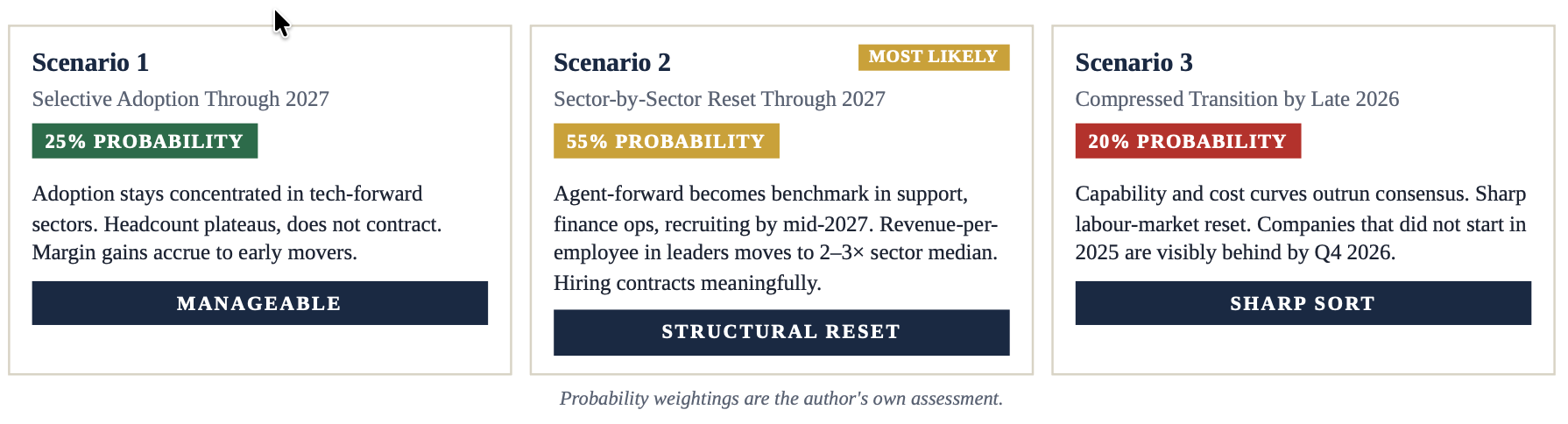
Why Scenario 2 is most likely. Agent-forward operations become the benchmark in customer support, financial back-office, recruiting, and middle-market professional services by mid-2027. For the UK, this collides with an economy still fragile from the Hormuz oil shock — sticky inflation, no rate cuts, the Bank of England not in a position to cushion. For the US, the picture bifurcates: companies with strong balance sheets capture the margin; thin operators struggle to fund the rebuild. Productivity statistics look strong at the macro level while labour-market data underneath looks worse than the headlines suggest.
The UK and the US Are Not in the Same Boat
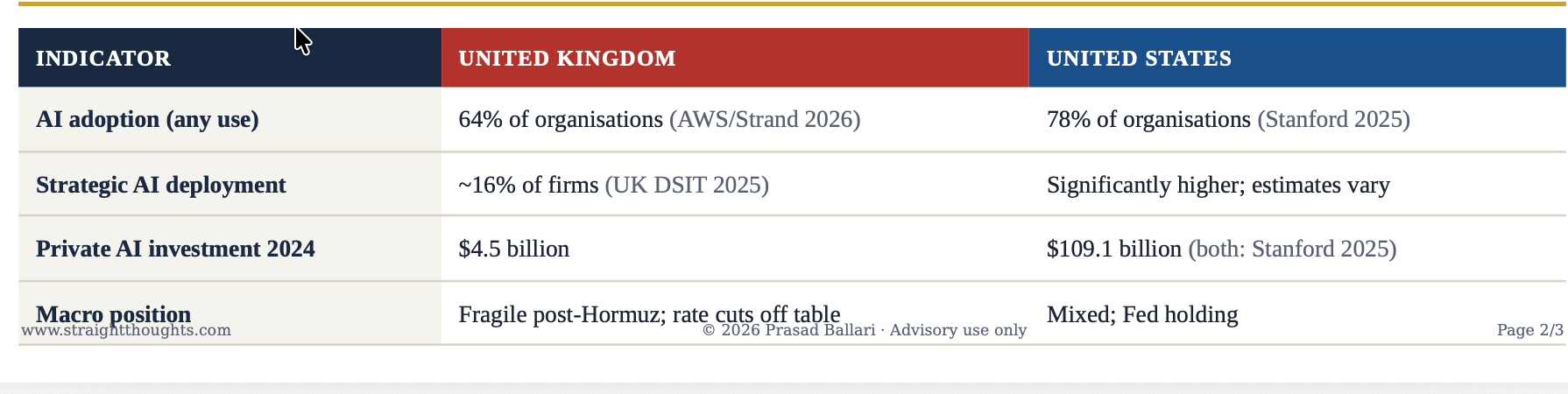
The UK is structurally exposed. Headline AI adoption is 64%, but only 24% of those adopters have reached the advanced stage where AI forms part of core business processes — up just one point year-on-year. Capital depth is a fraction of the US. Companies waiting for the government to lead on this will wait too long.
The US is differently vulnerable. Capability is not the risk. Speed is. The transition will be sharper and faster than the labour market can absorb. Watch labour-force participation in knowledge-work sectors over the next four quarters. That is where the signal lives.
What to Do This Quarter
The Watch List
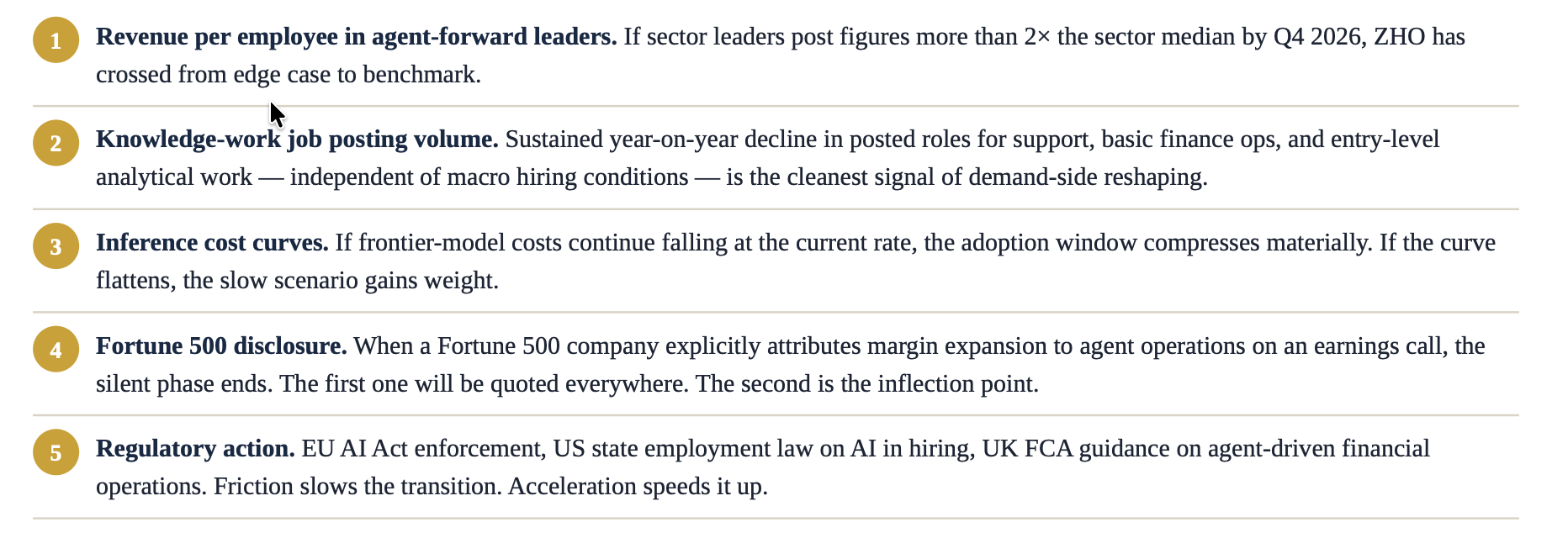
Five signals that will tell us which scenario we are in. Check these before Issue 3.
This is not a technology story you read and move on from.
It is a structural reset that will shape business, investment, and labour-market outcomes for the next decade.
The operators who treat it that way will navigate it. The ones who wait for certainty will be caught by it.
That's the straight thought.
Prasad Ballari · May 2026
Sources. Stanford HAI, 2025 AI Index Report (link) · Gartner, Predicts 40% of Enterprise Apps Will Feature Task-Specific AI Agents by 2026, Aug 2025 (link) · IMF, Gen-AI: Artificial Intelligence and the Future of Work, SDN/2024/001 (link) · McKinsey, The Economic Potential of Generative AI, June 2023 (link) · CNBC, Klarna CEO says AI helped company shrink workforce by 40%, 14 May 2025 (link) · Bloomberg, Klarna Turns From AI to Real Person Customer Service, 8 May 2025 (link).
StraightThoughts by Prasad Ballari · www.straightthoughts.com · © 2026
Independent advisory report. Not investment or financial advice.