The 60-Second Read
Full Article · 5 Min
The Problem
80% of Fortune 500 companies are already running AI agents in production. Most mid-market businesses are still in meetings about it. The gap is not technology. It is not budget. It is not access. Every CEO has access to the same AI. The gap is thinking.
The Numbers
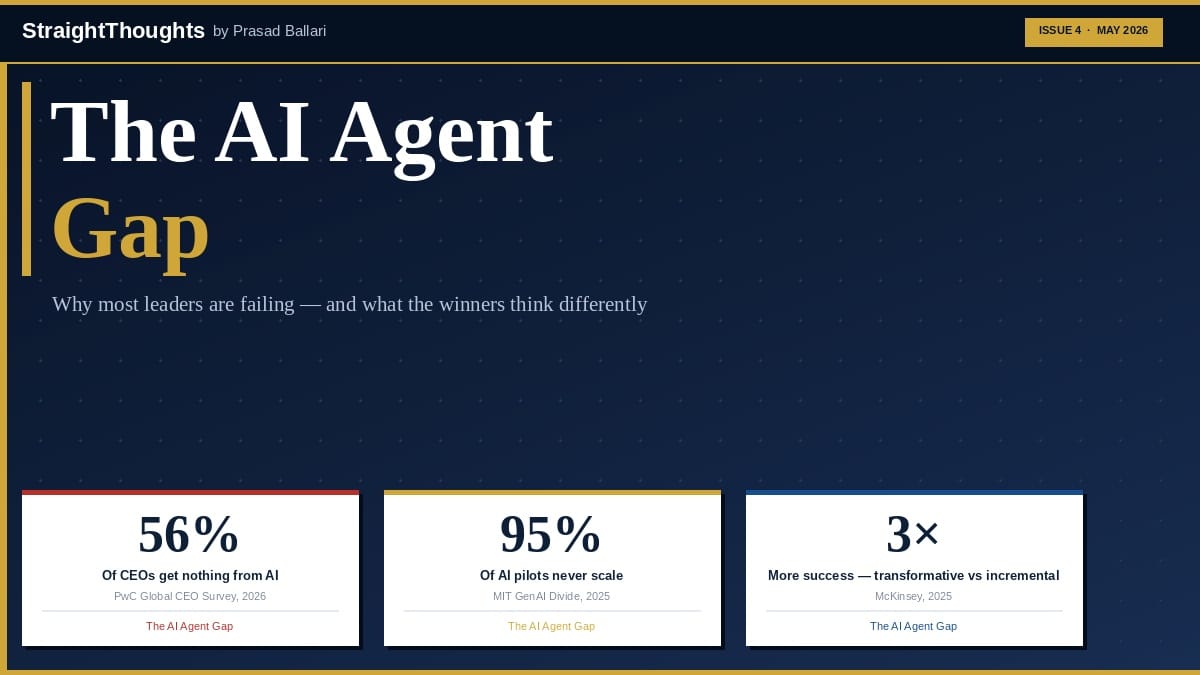
56% of CEOs report getting nothing from AI adoption. 95% of AI pilots fail to move beyond experiments. Yet the leaders who succeed are 3× more likely to use AI transformatively — not incrementally. The difference is not their AI. It is their question.
The Three Gaps
Thinking Gap — treating AI as a tool, not a transformation. Strategy Gap — deploying AI without a formal adoption strategy. Ownership Gap — nobody in the org chart is accountable for AI outcomes. All three are fixable. None are technical.
The Shift
The leaders winning with AI stopped asking "what AI tool should we buy?" They started asking "how do we reorganise around AI?" That is a management question, not a technology question. Most business leaders have never been trained to answer it. This issue is the starting point.
The Action
Stop piloting. Start deciding. Pick one revenue-critical workflow. Deploy one agent. Measure the outcome in 30 days. Companies with a formal AI strategy succeed at 80%. Those without: 37%. The strategy is not complicated. The decision to have one is.
The Straight Take
Every business leader is having a version of the same conversation this year. In the boardroom. In the offsite. In the one-on-one with the CFO.
"We need to be doing something with AI."
"We ran some pilots. Nothing really landed."
"Our team is resistant. We are not sure where to start."
"We are watching what competitors do first."
I hear some version of this every week. And I understand it. AI is genuinely complex. The landscape moves fast. The vendors are noisy. The promises are large. The results, so far, have been modest for most.
But here is the thing. The leaders saying these sentences are not behind because of technology. They are not behind because of budget. They are not behind because AI is too complex for their business.
They are behind because of how they are thinking about it.
The question most business leaders are asking is: what AI tool should we buy? The question winning leaders are asking is: how do we reorganise around AI? One is a procurement decision. The other is a management revolution.
— Prasad Ballari
The AI Agent Gap — Verified
What the data actually says about enterprise AI adoption in 2026.
56%
Of CEOs report getting nothing from AI adoption efforts
PwC Global CEO Survey, 2026
95%
Of AI pilots fail to move beyond the experimental phase
MIT GenAI Divide, 2025
29%
See significant ROI from AI — despite 97% claiming benefits
MIT NANDA / Writer.com, 2025
80%
Success rate for companies with a formal AI strategy
Writer.com, 2025
37%
Success rate without a formal strategy — same tools, half the outcome
Writer.com, 2025
3×
More likely to succeed when AI is treated as transformative, not incremental
McKinsey State of AI, 2025
You Have Already Tried This. You Just Have Not Named Why It Stalled.
Most business leaders have not avoided AI. They have tried it. They ran a pilot. They bought a tool. They sent the team to a workshop. They added "AI strategy" to the offsite agenda.
And then something happened. The pilot finished with no clear next step. The tool sat underused after the first month. The team kept working the old way because nobody changed the process around the tool. The offsite produced a slide deck that nobody actioned.
This is not failure. This is the normal pattern for leaders who are approaching AI as a technology decision. The technology was fine. The thinking around it was not.
There are three gaps underneath every stalled AI journey. None of them are on the vendor's slide deck. All of them sit in the leader's chair.
The Three Gaps
The Thinking Gap
Gap 1
"We deployed a chatbot for customer service. The team hated it. Customers complained. We switched it off. AI doesn't work for our business."
AI deployed as a tool on top of a broken process produces a faster broken process. The thinking error: buying AI before redesigning the workflow it sits in.
The reframe:
Don't ask: "what can AI do?" Ask: "which workflow, if rebuilt around AI, would change our competitive position?"
The Strategy Gap
Gap 2
"Every department is running their own AI experiments. IT doesn't know what Sales is doing. Finance has no visibility. Nothing connects."
Companies without a formal AI strategy succeed 37% of the time. Companies with one succeed 80% of the time. Same tools. Same teams. Different outcome. The only variable is intent made explicit.
The reframe:
An AI strategy is not a technology roadmap. It is a prioritised list of business outcomes you are committing to achieve with AI — with a name on each one.
The Ownership Gap
Gap 3
"The CTO thinks it's a business problem. The COO thinks it's a technology problem. The CEO thinks both teams are handling it. Nobody is handling it."
29% of employees admit to sabotaging company AI strategy. Resistance is not irrational. When mandates arrive without strategy, without ownership, and without clarity — rational people protect what they know.
The reframe:
AI needs a named owner for each outcome — not a committee, not a working group. One person. One metric. One deadline.
The root cause underneath all three gaps is the same. Most business leaders were trained to make technology decisions by evaluating technology. Buy the best tool, implement it well, and the outcome follows. That model worked for ERP. It worked for CRM. It does not work for AI agents. AI is not a tool you implement. It is a capability you organise around.
The Contrarian Take
One thing the market is getting completely wrong.
The market consensus is that AI adoption is a technology problem. The vendors say it. The consultants say it. The conferences say it. Buy the right platform. Integrate it properly. Train the team. The outcome follows.
I think that is wrong. And here is why.
MIT NANDA researchers found something important. Vendor-led AI deployments succeed at a 67% rate. Internally built AI tools succeed at 33%. The technology is identical. The difference is that vendor-led deployments come with an implementation structure — a defined outcome, a process redesign, and an accountability model. Internal builds rarely have any of those things. They have enthusiasm and a budget.
The technology has never been the constraint. The constraint is the management system around the technology. And most business leaders are spending all their energy on the first problem while ignoring the second entirely.
BCG put it precisely in their 2026 AI Radar: the leaders pulling away are not those deploying the most models. They are those treating AI as a management revolution — flattening hierarchies, redesigning decision rights, restructuring accountability around outcomes rather than functions.
That is a leadership skill. Not a technology skill. And it is the skill that separates the 80% who succeed from the 37% who don't.
The leaders winning with AI are not more technical than you. They are asking a different question. They stopped asking "what can AI do?" and started asking "what would we build differently if we knew AI could do it?"
— Prasad Ballari
The Four Mindset Shifts Required
Every business leader I have seen succeed with AI agents made four shifts. Not simultaneously. In sequence. Each one unlocking the next.
1
From Tool Buyer to Architect
Stop evaluating AI tools. Start designing AI workflows. The tool is the last decision, not the first. The first decision is: which business outcome am I committing to? The second: which process must change to achieve it? The tool that fits that process is the right tool. Leaders who start with the tool almost always end with a pilot that goes nowhere.
2
From Efficiency Seeker to Outcome Owner
Most leaders deploy AI to save cost or save time. Both are valid. Neither builds competitive advantage. The leaders building moats are using AI to do things they could not do before — respond in five minutes instead of 42 hours, surface every renewal 30 days early, close every complaint before the customer thinks to leave. The question is not "how do we do this faster?" It is "what could we do if speed was no longer a constraint?"
3
From Pilot Runner to Decision Maker
Pilots are how you avoid commitment. They are useful for six weeks. After that, they are how you stay comfortable while the market moves. The leaders succeeding with AI made a decision — this workflow, this agent, this outcome, this quarter — and held themselves accountable to a result. 95% of pilots fail because they are designed to be evaluated, not to be deployed. Make the decision. Measure the outcome. Adjust.
4
From Team Protector to Culture Builder
29% of employees admit sabotaging their company's AI strategy. This is rational behaviour. When leaders mandate AI adoption without explaining what it means for the team — what changes, what stays, what the human role becomes — people protect what they know. The leaders with the highest adoption rates are not the ones with the best technology. They are the ones who made the human case first. AI handles the follow-up. You handle the relationship. The agent never replaces the human. It makes the human faster.
Three Scenarios for 2026–2027
Scenario 1
The Cautious Waiter
30% of businesses
Watching competitors. Running one more pilot. Waiting for the technology to mature. By Q4 2026, the gap they are waiting to close will be 18 months wider. The technology matured six months ago. What they are actually waiting for is permission to decide.
Falling Behind
Scenario 2 Most Likely
The Selective Mover
55% of businesses
Picks one or two workflows. Deploys agents there. Measures outcomes. Builds confidence. Expands. This is not the fastest path. It is the most durable one. Revenue-per-employee in these companies will be 1.5–2× sector median by end of 2027.
Building the Moat
Scenario 3
The Full Restructure
15% of businesses
Redesigns the org around AI. Flattens hierarchy. Rebuilds decision rights. Moves from function-led to outcome-led. BCG Trailblazers. By 2028, Gartner projects 15% of daily business decisions will be made by AI agents. These companies will be there first.
Category Leader
What to Do This Quarter
- Stop piloting. Start deciding. Name one revenue-critical workflow. Commit to deploying an agent there within 30 days. Not evaluating. Deploying. The pilot mindset is the reason 95% of AI experiments go nowhere. Decisions have owners. Pilots have committees.
- Write your AI strategy in one page. Not a roadmap. Not a vision deck. One page: the three business outcomes you are committing to achieve with AI this year, the workflow that delivers each one, and the name of the person accountable for each result. Companies with this document succeed at 80%. Without it: 37%.
- Make the human case before the technology case. Before deploying any agent, tell your team what it does and what it does not do. The agent handles the follow-up. The human handles the relationship. The agent surfaces the renewal. The human closes it. When the team understands this, adoption follows.
- Start with Attention. Lead response. Follow-up cadence. Renewal alerts. Complaint escalation. These are the workflows where agents deliver the fastest, most measurable return. This is where your Leakage Index (Issue 3) is highest. It is also where AI agents are most mature and most deployable today.
- Measure in 30 days, not 90. The leaders succeeding with AI move fast not because they are reckless but because they set a 30-day outcome and hold it. If the outcome lands, expand. If it does not, adjust — not abandon. The companies watching competitors are waiting for certainty that only action produces.
The Metric — AI Readiness Index (ARI)
Definition
AI Readiness Index (ARI) measures your organisation's actual capacity to deploy and scale AI agents — not your intention to do so.
ARI = (Named Outcomes × Owned Workflows × Formal Strategy)
scored 1–10 across three dimensions
Three Dimensions
Strategy clarity — do you have named outcomes, or just intentions?
Ownership depth — does every AI initiative have one named owner with one metric?
Execution speed — how long from decision to deployed agent in your organisation? Under 30 days is the benchmark. Over 90 days means the process is the barrier, not the technology.
The Honest Question
Score yourself on each dimension from 1–10. If your total is below 15, you are not behind on AI. You are behind on management. Fix the management. The AI will follow.
The Watch List
Five signals that will tell us which businesses are genuinely building AI capability versus performing it. Check these before Issue 5.
1
Time-to-deploy falling below 30 days. The current median time from AI decision to live deployment in mid-market businesses is 90–120 days. The companies compressing this to under 30 days are building an execution muscle their competitors will not be able to replicate quickly.
2
AI ownership appearing in job titles and KPIs. Not "Head of AI." That is a technology title. Watch for: COO with AI transformation in scope, CRO with agent deployment as a quarterly KPI, CFO reporting AI-attributed revenue separately from baseline growth.
3
Employee resistance falling as communication improves. The sabotage rate (currently 29%) is a leading indicator of poor change management, not poor technology. Watch for companies reporting falling resistance alongside rising AI deployment — that is the culture shift that makes AI sticky.
4
Revenue-per-employee diverging within sectors. By end of 2027, the gap between AI-first and AI-watching companies will be visible in revenue-per-employee ratios. This is the metric that will make boards ask hard questions. Watch sector medians begin to split.
5
Gartner's 15% threshold arriving early. Gartner projects 15% of daily work decisions will be made by AI agents by 2028. If sector leaders hit this by mid-2027 — twelve months ahead of consensus — the Cautious Waiters will not have 18 months to close the gap. They will have six.
The AI gap is not a technology gap. It is a leadership gap. Every business leader has access to the same agents, the same models, the same infrastructure. The ones pulling away are asking a different question — and committing to a different standard of answer.
— Prasad Ballari
That's the straight thought.
Prasad Ballari · May 2026
Sources: PwC Global CEO Survey 2026 · MIT GenAI Divide: State of AI in Business 2025 (MIT NANDA initiative) · Writer.com, Enterprise AI Adoption 2026 · Writer.com, Generative AI Adoption in the Enterprise 2025 · McKinsey, The State of AI 2025 · BCG AI Radar 2026: As AI Investments Surge, CEOs Take the Lead · Gartner, Top Strategic Predictions for 2026 · IMD, 2026 AI Trends: What Leaders Need to Know · Q1 2026 Enterprise AI Adoption Review.
Continue the Conversation
Read every issue at www.straightthoughts.com
For direct conversation: [email protected]
If this issue made you rethink one decision in your business, forward it to someone who needs to see it.